


After losing a tooth, don’t stand between the two “giants” of prosthetic dentistry: Porcelain Bridge—the classic, fast solution—and Dental Implant—the gold standard for durability and strength. The choice that will bring you a confident smile and maximum chewing ability is waiting. Which one is truly the wisest long-term investment for your future?
After reviewing the similar Pros and Cons of a Porcelain Bridge in the previous article, you now have a clearer understanding of an effective solution that comes with certain “trade-offs.” Today, this direct confrontation is the final and most important step for you to have a complete answer. This article will be a comprehensive “showdown,” comparing the porcelain bridge and the implant across crucial “rounds”: health, aesthetics, durability, and cost. Join me in conducting a thorough survey to find the true “champion” for your own smile.
Understanding the “Rivals”: Completely Different Operating Principles
Before comparing, let’s quickly review the fundamentally different nature of these two methods.
Porcelain Bridge – Principle of “Bridging Based on Existing Foundations”
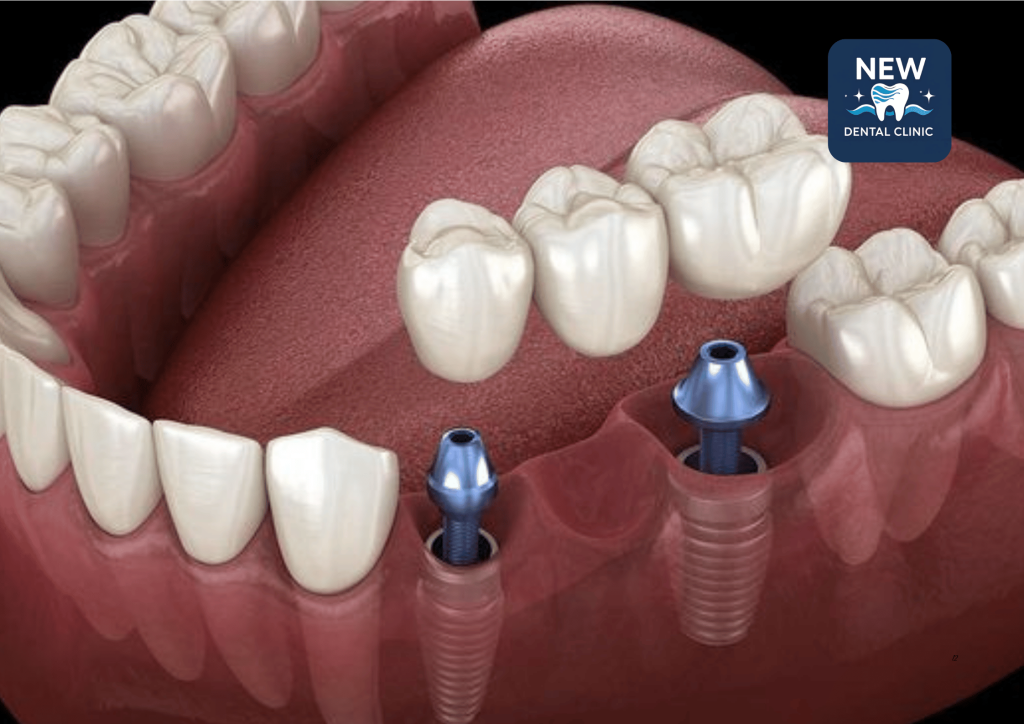
The porcelain bridge works by utilizing two healthy teeth adjacent to the gap as abutments. The doctor must shape (shave down) these two natural teeth and place a connected unit of 3 or more crowns over them. The false tooth in the middle will cover the missing tooth gap, resting on the gum.
- Philosophy: Utilizing and relying on the remaining natural teeth for quick restoration.
Dental Implant – Principle of “Recreating a New Foundation”
Dental Implant is a process that completely recreates a single, standalone tooth from the root up. The doctor will surgically place a Titanium post into the jawbone to act as an artificial tooth root. After successful osseointegration, a porcelain crown will be attached on top.
- Philosophy: Does not rely on any other tooth, creating a new, independent, and durable structure from the foundation.
Comprehensive “Showdown”: Comparing Porcelain Bridge and Implant Across 8 “Rounds”
Now is the time to put both solutions on the scale, comparing each critical criterion.
Round 1: Impact on Natural Teeth – The Preservation Factor
- Porcelain Bridge: Loses. This is the biggest drawback. The doctor is forced to reduce (shave down) two strong adjacent natural teeth. The tooth enamel that is removed is lost forever, and the two supporting teeth must bear the burden for the rest of their lives.
- Dental Implant: Absolute Win. The implant is an independent unit, surgically placed directly into the missing tooth space. It is completely non-invasive and does not affect any surrounding teeth. This is the principle of maximum preservation of the natural tooth structure.
Round 2: Jawbone Preservation – The Fight Against Aging
- Porcelain Bridge: Loses. Because only the upper part of the tooth is replaced, the jawbone underneath the bridge receives no stimulation. Over time, this bone area will gradually resorb, causing cheek collapse, gum recession, and creating a space that looks aesthetically unpleasing.
- Dental Implant: Absolute Win. The Implant post acts as a natural tooth root, continuously transmitting chewing force to the jawbone. This process stimulates and maintains bone density, completely preventing bone resorption—an invaluable health benefit that no other solution offers.
Round 3: Chewing Function – Who is Stronger?
- Porcelain Bridge: Good. It can restore about 70-80% of the chewing force compared to a natural tooth. You can comfortably eat most types of food. However, the chewing force is borne by the adjacent supporting teeth, making them work harder.
- Dental Implant: Excellent. Restores over 95% of the chewing force. It is an independent and secure “root,” bearing its own load. You can confidently eat any food without worry.
Round 4: Long-Term Aesthetics – The Durability of Beauty
- Porcelain Bridge: Good. Excellent aesthetics initially, but can be compromised after 5-10 years if the jawbone recedes, potentially exposing the margin of the crown near the gum line.
- Dental Implant: Excellent. The aesthetics are stable and natural from the gum line. Because the implant prevents bone loss, the gum line remains stable, ensuring long-term aesthetic perfection.
Round 5: Lifespan – The Long-Term Investment
- Porcelain Bridge: Good. The average lifespan is 10-15 years. This lifespan depends heavily on the health of the two supporting teeth. If one of the supporting teeth decays, the entire bridge must be replaced.
- Dental Implant: Excellent. An Implant can last 20 years, 25 years, or even a lifetime with proper care. The success rate of an Implant after 10 years is 95-98%. The porcelain crown on top may need replacement after 15-20 years, but the Implant post underneath remains intact.
Round 6: Treatment Time – The Speed Race
- Porcelain Bridge: Absolute Win. The entire process can be completed within 3-7 days over 2-3 appointments.
- Dental Implant: Loses (in terms of time). The process requires more time, averaging 3-6 months, to allow sufficient time for the Implant post to firmly integrate with the jawbone before the final crown can be attached.
Round 7: Daily Hygiene – Convenience
- Porcelain Bridge: More Difficult. You cannot use normal dental floss. You are forced to use special tools like floss threaders (Super Floss) or a water flosser to clean the area beneath the bridge.
- Dental Implant: Easy. Because it is a separate tooth, you can floss and brush it just like a natural tooth using conventional dental methods.
Round 8: Cost – The Economic Calculation
- Porcelain Bridge: Lower Initial Cost. Although you have to pay for 3 porcelain units, the total initial cost is lower compared to a bone grafting or complex Implant case.
- Dental Implant: Higher Initial Cost. This is a larger investment upfront because it includes the cost of surgery and high-grade Titanium material.
Expert Advice: So, Which Option is Right for You?
After the “showdown” above, it is clear that the Implant dominates in most important aspects of health and durability. However, that does not mean the porcelain bridge is without value. The final decision should be based on your personal situation and priorities.
Choose a PORCELAIN BRIDGE when:
- Your adjacent teeth already have existing problems: If your adjacent teeth have large fillings, have undergone root canal treatment, or are aesthetically unpleasing, combining the bridge is a very effective “two birds, one stone” solution.
- You need a solution quickly due to time constraints: You need a new tooth immediately for an important event.
- Your health conditions do not allow surgery: Patients with certain severe, uncontrolled chronic diseases.
- You are concerned about the initial financial outlay.
Prioritize a DENTAL IMPLANT when:
- Your two adjacent teeth are completely healthy: Don’t sacrifice a perfect tooth unnecessarily. This is the top indication for an Implant.
- You prioritize long-term health and stability: You want to prevent bone resorption and preserve your facial structure.
- You want the best chewing function and feeling: You want zero complications in daily life.
- You view it as a “once-in-a-lifetime” investment.
Thus, after comparing the porcelain bridge and the implant, you have a very clear overview of the two leading options for tooth loss restoration. Each solution has its place in modern dentistry. If, after careful consideration, you feel the porcelain bridge is still the more suitable solution for your current conditions and wishes, the next step is to fully understand the execution process you will undergo. To help you feel completely secure and prepare best, let’s explore the next article: “Detailed Porcelain Bridge Procedure.”
